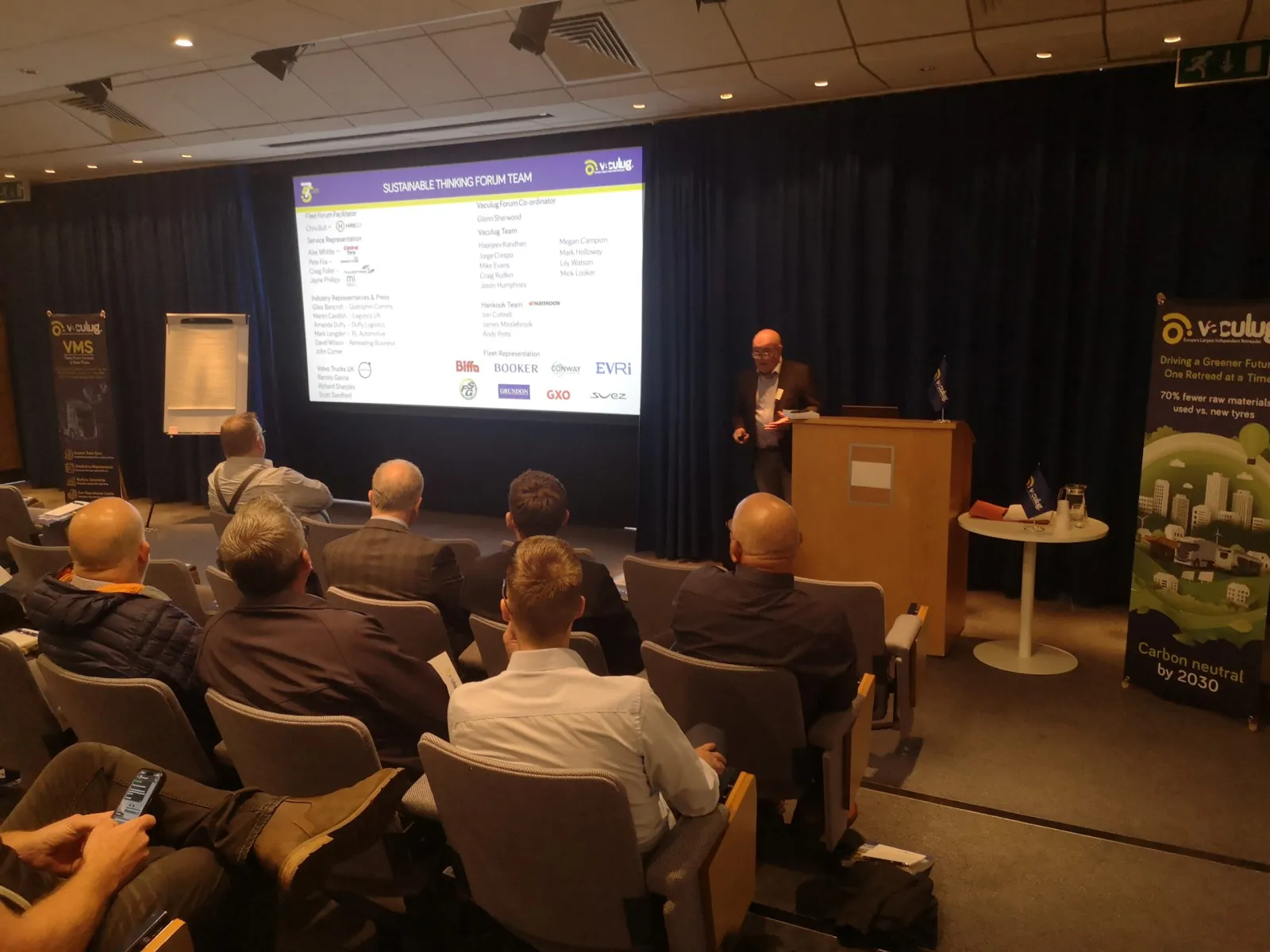
The sixth Vaculug Sustainability Forum brought together around 30 industry representatives at Volvo’s UK headquarters in Warwick on 7 October, with the focus on how the tyre sector can address immediate sustainability challenges while developing longer-term solutions.
Volvo Hosts Latest Tyre Forum Event
Held under the strapline “Meeting Today’s Challenges for Tomorrow’s Future”, the forum was moderated by Glenn Sherwood, Vaculug’s Chief Growth Officer. Discussions covered a broad range of issues, from tyre costing and abrasion emissions to recruitment and the industry’s engagement with Government.
Sherwood used the opening session to highlight the practical value of initiatives already developed through the forum. These included the Drive Tyre Safety Toolbox Talk video, produced in conjunction with Biffa, and the launch of the V-Torque wheel nut torque settings app.
For Sherwood, the development of initiatives with a practical application provides an important justification for continuing to build the forum as a platform for wider industry collaboration and future projects.
Taking the tyre industry to Westminster
The forum also provided an update on the Forum’s Westminster Project, which began with a visit to the 2025 Labour Party Conference.
As part of the project, the Group submitted a Freedom of Information request to Borough, District and City Councils in January 2026. The results highlighted what Vaculug sees as a significant gap in the adoption of remanufactured tyres within the public sector. The research found that 43% of councils had purchased zero remanufactured tyres, while 21% had fitted single-life tyres only.
Following the FoI exercise, the Group has engaged with a number of political and industry figures, with varying degrees of success. These have included Ruth Cadbury, Chair of the Transport Select Committee; Richard Holden, Shadow Secretary of State for Transport; Gareth Davies, MP for Grantham and Shadow Finance Secretary; Daisy Cooper MP, as part of a Make UK round table; Paul Bristow, Mayor of Cambridgeshire and Peterborough; and Rob Halfon, Executive Director at Make UK.
According to Sherwood, the next stage of the project will be to develop a Tyre Manifesto and establish a more united voice for the UK tyre industry. The objective is to create a coherent industry agenda ahead of and into the next General Election.
The Group also plans to organise another industry round table in Westminster during the first or second quarter of 2027.
The Westminster initiative represents an attempt to move sustainability discussions beyond individual company initiatives and towards a broader industry position, particularly on the role that remanufactured products can play within public-sector procurement.
Moving from tyre assumptions to evidence
Another theme running through the forum was the importance of better data in making sustainability and commercial decisions.
Jason Humphries, Vaculug’s Logistics and IT Director, outlined the company’s latest developments, including the creation of Veritas, a tyre costing model designed to provide a more detailed assessment of tyre performance and cost.
“The purpose of Veritas is simple,” said Humphries, “to replace assumption with evidence, so every tyre delivers its full working life, and no fleet pays for what it cannot see.”
The model has now been completed and is ready for use with Vaculug’s fleets. Humphries explained that it had been validated against the company’s existing costing model before going live.
An important feature of the approach is that each fleet is costed by a cost accountant, meaning that each model begins with what Vaculug describes as a precise, professional baseline. The intention is therefore to move tyre-cost analysis away from assumptions and towards a more consistent assessment of the actual cost and working life of tyres.
Sustainability beyond rolling resistance
The forum also examined the increasingly complex sustainability considerations surrounding truck tyres.
Jon Cottrell, Hankook’s TBR Operations and Service Network Manager, provided an insight into Hankook’s approach to sustainability in the truck tyre sector, including the importance of tyre particle emissions resulting from abrasion.
“This is important commercially,” said Cottrell, “because a tyre cannot simply be optimised for low rolling resistance in isolation. Manufacturers increasingly must consider the balance between energy efficiency, durability and abrasion emissions.”
The issue highlights the fact that sustainability cannot necessarily be reduced to a single performance characteristic. Improving one aspect of tyre performance may have implications for other areas, meaning that manufacturers and fleet operators need to consider the overall balance between efficiency, durability and tyre wear.
Cottrell also pointed to the difference between single-use tyres and premium new and retreaded tyres in terms of tyre wear particles. According to the figures presented at the forum, single-use tyres typically create 95–129% more tyre wear particles than premium new tyres and retreaded tyres.
For an industry increasingly focused on the environmental impact of tyres throughout their working lives, this places greater emphasis on considering the complete life cycle and performance of a tyre rather than focusing on individual characteristics in isolation.
The missing part of sustainability
The forum also addressed an issue which is less directly associated with environmental sustainability but which the organisers see as equally important to the long-term future of the sector: recruitment.
Glenn Sherwood and Alex Whittle, Divisional Director at Central Tyre, discussed the challenge under the heading “Building a Sustainable Workforce”, describing recruitment and workforce development as “The Missing Part of Sustainability.”
The inclusion of workforce issues alongside tyre technology, environmental performance, costing and government policy reflects the forum’s broader interpretation of sustainability. For the businesses represented, long-term sustainability is not simply a question of reducing environmental impact. It also involves ensuring that the industry has the people and skills required to maintain and develop its operations.
Taken together, the discussions at the sixth Sustainability Forum demonstrated a move towards a broader definition of sustainability within the commercial tyre sector. The emphasis was not simply on environmental targets, but on practical initiatives, evidence-based tyre management, product performance, public policy and the development of a sustainable workforce.
The forum’s ongoing projects, including its Westminster engagement and industry initiatives, also suggest an increasing focus on collective action. Rather than sustainability being treated solely as an individual company responsibility, Vaculug is using the forum to explore areas where collaboration across the sector could help establish common priorities and influence the wider industry agenda.
Image: Commercial Tyre Business