Some companies build their fleet technology system as a tool that runs everything. Prometeon takes a narrower view of what it is trying to solve, building software mostly around one question: how can tyre management become simpler for the fleet, without asking the fleet to change everything else it already uses.
Simplicity at its Core
For Ilke Bor, Marketing Manager for North Europe at Prometeon, the immediate value of the platform comes down to visibility and simplicity. “For us, the immediate value is about making tyre management simpler and giving the fleet visibility and control.”
Let’s take a look at their two central tools: Pro Management and Pro Check.
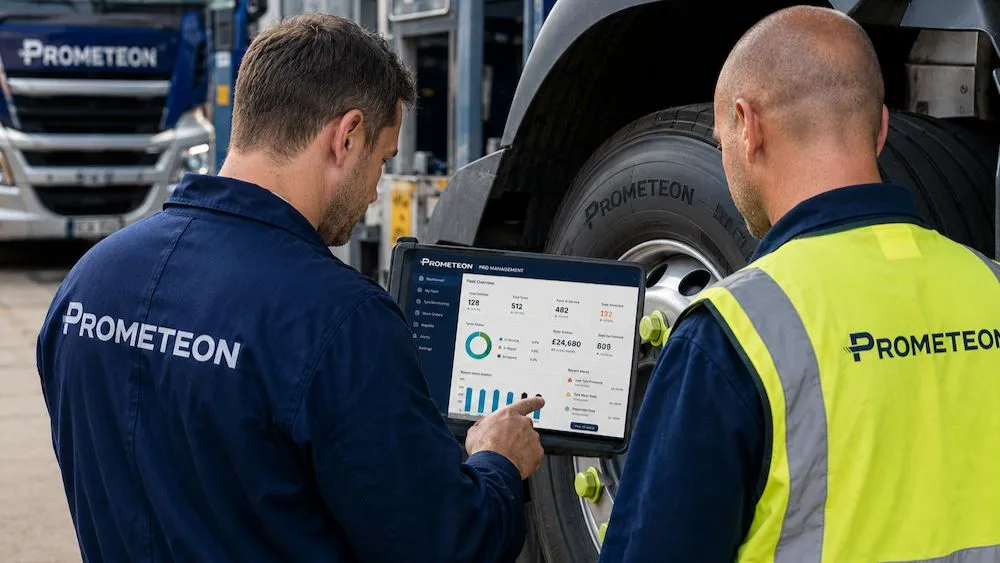
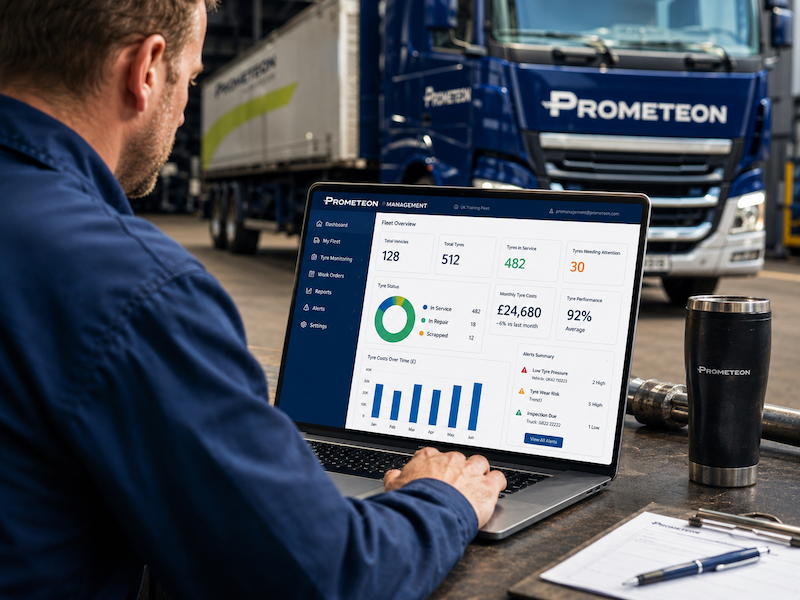
Pro Management, Prometeon’s central billing and tyre management platform, brings tyre-related work from across the company’s participating dealer network into a single place. Rather than dealing with different invoices and formats from multiple suppliers, fleets get consistent pricing and one source of invoicing. Fleet managers can view and authorise work, search by vehicle registration, look back at previous jobs and tyre fitments and filter information by depot, dealer or job status, with activity visible at both fleet-wide and individual branch level.
Pro Check, a companion tool, covers the inspection side of the equation, allowing tyre inspections to be recorded digitally through a mobile app and measurement tools, with the resulting data feeding into the wider Pro Services environment under the same login. “Rather than simply giving fleets more data, the aim is to give them practical information they can use day to day,” Ilke explains.
Prometeon Focusing on Total Efficiency Gains
Asked where the biggest cost savings actually come from, Ilke avoids picking just one category. Prometeon’s approach, Ilke explains, looks at total cost of ownership rather than isolating a single saving; extending tyre life and avoiding unnecessary maintenance and downtime tend to matter the most.
A tyre that is checked regularly and managed properly has a much better chance of reaching its full performance potential. Pro Check is designed to support exactly that, recording tyre condition and measurements digitally, so issues can be found early rather than after a tyre has already been removed too soon or worn down too far. Ilke notes that fuel efficiency is also benefited indirectly, since keeping tyre condition and pressure correct is part of running an efficient vehicle, even if that particular saving is hard to separate from everything else happening across a fleet.
Digitising the inspection itself is, in Ilke’s view, one of the more meaningful efficiency gains. “Pro Check uses a mobile app which can connect to Bluetooth inspection equipment, allowing vehicle and tyre data to be captured during the inspection and transferred into the platform, rather than recorded manually and entered again later.”
Once that data is captured, tools such as tyre-life forecasting help fleets plan ahead instead of only reacting once something has already gone wrong.
Specialist Tyre Management Driving Prometeon’s Strategy
Where some providers are building toward becoming a fleet’s central operating system, Prometeon is deliberately not trying to go there. “Our expertise is tyres and we believe that specialism is important,” Ilke explains. “We are not trying to replace the transport, telematics or workshop management systems a fleet already uses.”
Both Pro Management and Pro Check offer a public API, allowing their data and analytics to be pulled into other applications a fleet already relies on. Ilke points out that many fleets have already invested heavily in their own systems and are not necessarily looking for another standalone source of information sitting on top. Prometeon’s focus, Ilke says, stays on specialist tyre management, connected outward rather than trying to absorb everything into itself.
More Data Does Not Equal More Value
Ilke is direct about the limits of simply generating more information for fleet managers to look at. “Providing more data does not automatically provide more value,” Ilke says. “The challenge is to give the fleet information it can actually use.”
That idea shaped a recent upgrade to Pro Management, which improved search and filtering, simplified navigation and made it quicker for fleet managers to reach information on activity, approvals, costs and vehicle job history. Pro Check follows a similar logic on the inspection side, offering online reporting and analysis rather than leaving managers to work through inspection records by hand.
“The systems can also integrate with other applications, helping tyre data sit alongside the information fleets already use rather than creating another standalone source of data. Ultimately, technology should reduce workload for the fleet manager, not give them another portal they constantly have to monitor,” Ilke explains.
Starting from the Fleet, Not from the Product
Rather than applying one fixed rollout to every customer, Prometeon’s approach begins with how a specific fleet currently manages its tyres. Ilke describes it as identifying where the administrative or operational pressure actually sits and building from there, with ease of use treated as a genuine priority rather than an afterthought – again pointing to the recent Pro Management upgrade, which focuses on fewer steps, clearer screens and faster workflows.
“There isn’t one ROI period that will apply to every operator, because it will depend on the size and structure of the fleet, how tyres are currently managed and the level of implementation,” Ilke explains when talking about operational benefits and its timings.
Some benefits, though, tend to appear almost immediately, simply from cutting manual processes and giving managers clearer information, with the larger financial return building over time through better tyre utilisation, earlier intervention and tighter cost control.
AI at Work and in Development
Both Pro Management and Pro Check are built in-house by Prometeon’s own software development team and AI already plays a role on the inspection side specifically. Pro Check uses AI and machine learning for data analytics, including optimising tyre stock levels and forecasting future requirements, being able to automatically predict how much monitored tyre life remains.
“Pro Check analyses inspection data to help optimise tyre performance and forecast when tyres are likely to need replacing,” Ilke explains.
Pro Management, on the other hand, does not yet use AI in the same way, although Ilke says that capability is expected to arrive as part of the platform’s next update in 2027, suggesting the technology will extend across both tools over time rather than staying limited to inspections.
Prometeon’s Tailored Fleet Support
“Digital tyre management isn’t only relevant to large fleets. A smaller operator may have fewer vehicles or depots, but it still needs to control tyre costs, understand tyre condition and keep vehicles on the road,” Ilke says.
Through its Pro Services offer, Prometeon builds a level of support around each customer individually rather than applying one approach across the board. For an SME specifically, Ilke frames the value in practical terms: less administration, clearer visibility of tyre condition and cost and getting the best possible life out of the tyres already on the fleet.
Prometeon is comfortable not trying to do everything. Rather than chasing a bigger role inside a fleet’s technology, the focus stays on tyres and making sure that whatever data comes out of Pro Management and Pro Check is easy to act on, not just easy to collect. For smaller fleets in particular, this seems to translate into something simpler: fewer things to manage, not more. As Ilke puts it, the value should always come back to practical outcomes, not the size of the platform delivering them.