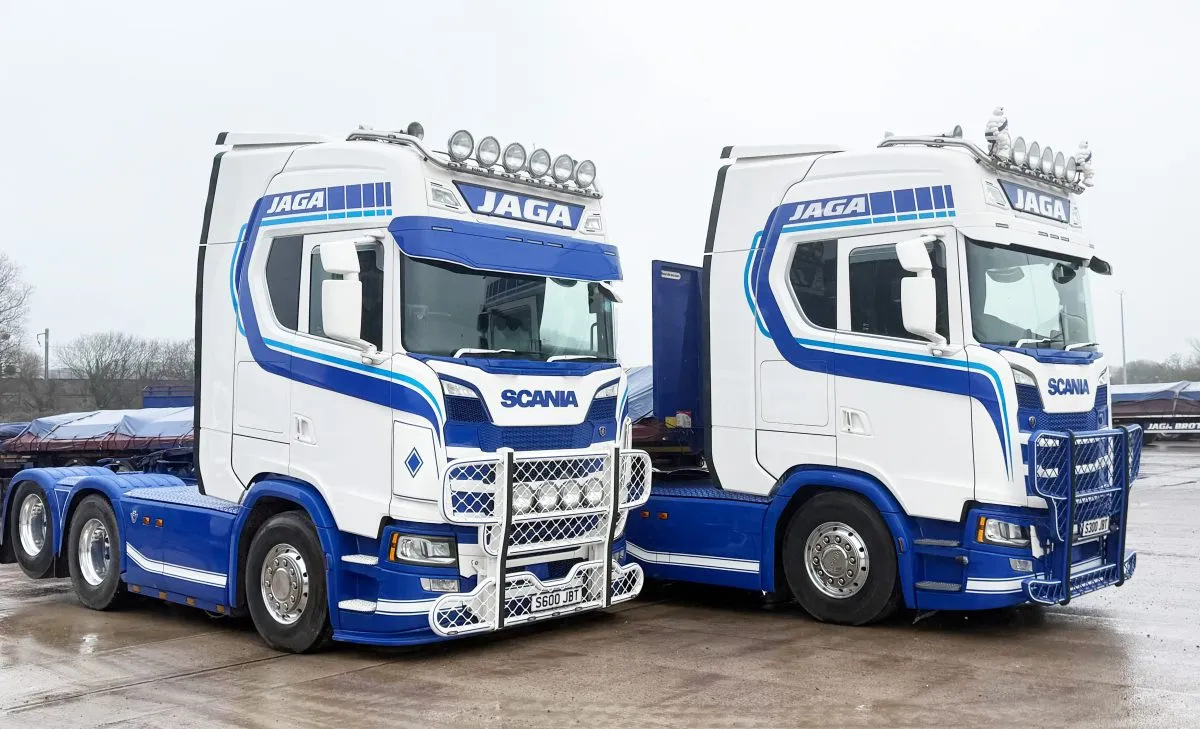
Welsh haulier JAGA Brothers has slashed tyre costs by a third and reduced breakdowns after switching its fleet to a Michelin tyre policy.
Michelin Policy Cuts Monthly Tyre Costs by 33%
Adopting a Michelin tyre policy has taken the performance of Welsh operator JAGA Brothers’ hard-working fleet to a new level, reducing its monthly tyre spend by a third and cutting tyre-related breakdowns.
Since signing up with Michelin in 2023, the general haulier, which utilises a range of MICHELIN X-Multi and X-Line Energy family products, has gradually transitioned its fleet – comprising close to 50 tractor units and 130 trailers – to the manufacturer’s high-performing products as older fitments have come to the end of their lives.
James Hill, co-Director of the firm with brother Gary, says: “Yes, the tyres may be more expensive than some rival products initially, but they last that much longer – for us two to two and a half years on average – meaning you soon make your money back and more.”
Hill says that while there was a cost bump when transitioning to a Michelin policy, as things have bedded in, the business’s monthly tyre spend has fallen by a third thanks to improved performance.
Fewer Tyre Failures Boost Fleet Reliability Across UK Operations
As well as the improved tyre longevity, JAGA Brothers – which covers the breadth of the UK with its trucks clocking up an average of 180,000km a year transporting steel from Newport and Cardiff before returning with backloads of bricks – now experiences far fewer tyre failures. This is thanks to the product’s quality and the service provider Tuf Treads’ daily fleet checks.
“That’s significant, as it’s not just the price of the tyre when you have a breakdown that hurts. It’s the resulting missed delivery, the vehicle downtime, and potential for additional damage,” adds Hill.
Multi-Life Tyre Strategy and Low Rolling Resistance Drive Further Savings
Supported by Howard Taylor, Senior Territory Business Manager for South & West Wales at Michelin, JAGA Brothers makes use of a Michelin multi-life policy to reduce the total cost of ownership of its tyres. Worn tyres are regrooved on site once the tread depth reaches 4mm, helping extend each tyre’s life while keeping it in its most fuel-efficient state. Once the regrooved fitments have worn out, they can be retreaded at the Michelin Remix plant in Stoke – a process that saves natural resources, doubles the lifespan of Michelin casings, and supports UK manufacturing.
“We take them off at 4mm as company policy, but Howard said that if we went to 3mm, we could potentially save more without affecting performance. It’s something we’re weighing up that could unlock further savings in the future,” adds Hill.
As well as using Multi Energy, Multi HD and Multi T fitments, the firm is phasing in low-rolling-resistance X Line Energy 2 tyres, replacing the first generation of the product, to maximise fuel savings on long-distance work.
The haulier also benefits from MICHELIN Connected Fleet’s data analysis expertise, which it uses to identify harsh driving events to aid driver coaching, as well as monitoring tyre pressures across the fleet.