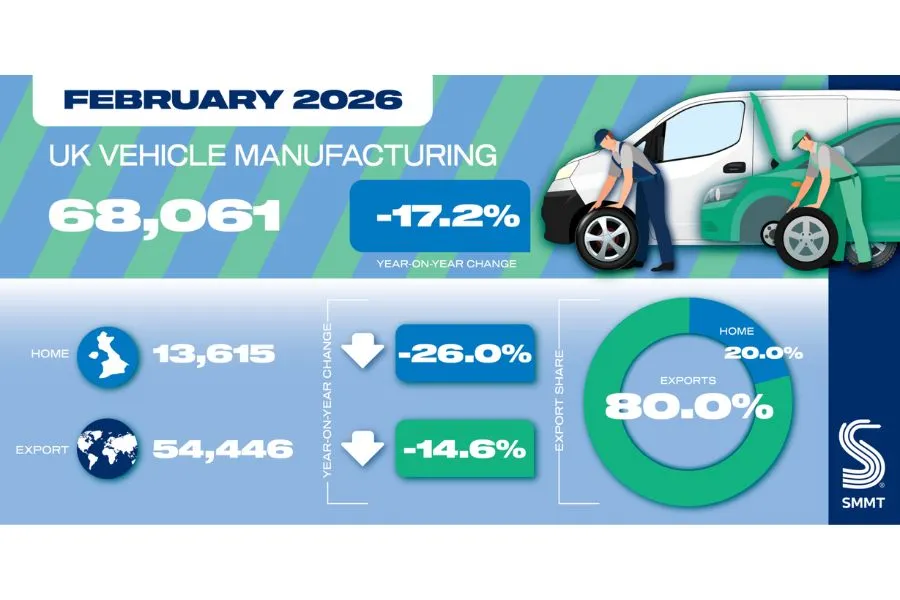
The latest SMMT report shows the UK vehicle production declining in February 2026, reflecting weak export demand in markets outside Europe and the current difficult conditions for manufacturers worldwide.
Weak Global Demand
UK vehicle production declined by 17.2% in February, with 68,061 units leaving factories, according to the latest data from the Society of Motor Manufacturers and Traders (SMMT). Commercial vehicle production in the UK declined by 74%, with 2,176 vehicles. Commercial vehicle exports went down by 65.1% with 1,306 units, even though production for overseas buyers still accounted for the majority (80.0%) of total vehicle output. The EU remained the largest global market for UK plants, taking 88.9% of CV shipments.
Commercial vehicle production for the UK buyers also declined steeply, by 81.2%, down to just 870 units. The news comes amid fresh global turmoil, notably in the Middle East, and with the UK sector facing additional pressure from ‘Made in the EU’ proposals set out in the European Commission’s Industrial Accelerator Act, according to SMMT. As drafted, they would discriminate against UK-made vehicles and components – damaging a trading relationship worth almost £70 billion annually and potentially breaching the EU-UK Trade Cooperation Agreement – the Brexit deal – which all parties worked so hard to secure in 2020.
Mike Hawes, Chief Executive, SMMT, commented: “Another decline for UK vehicle production and exports is extremely worrying, given these figures pre-date the crisis in the Middle East. While the sector has made efforts to build resilience into its logistics and supply chains post Covid, the conflict adds further strain. Now more than ever, we must focus on our industrial competitiveness by driving down energy costs, backing our suppliers, supporting our domestic market and securing free and fair trade with Europe.”
Global demand for new vehicles is weak, the changeover model is ongoing, and a major plant is going through restructuring – all of these factors impact the volumes, while the immediate outlook is uncertain, particularly since these figures predate the crisis in the Middle East, the impact of which, if the conflict is prolonged, could be significant, SMMT highlighted.
SMMT called for governments to work together to extend full, trusted partner status to the UK automotive sector, which would drive economic growth and security across Britain and Europe, supporting rather than risking jobs and improving industrial competitiveness amid multiple global headwinds. This would also ensure choice and affordability for consumers, particularly of zero-emission vehicles, on both sides of the Channel.
Despite all the headwinds, the UK automotive sector continues to invest in decarbonisation, with electrified vehicles accounting for 40.4% of car output last month. Most of these models are exported to Europe, and last year Britain reciprocated by importing more than 290,000 battery electric vehicles (BEVs) from the EU, covering 61.6% of the UK BEV market.
Image credit: SMMT