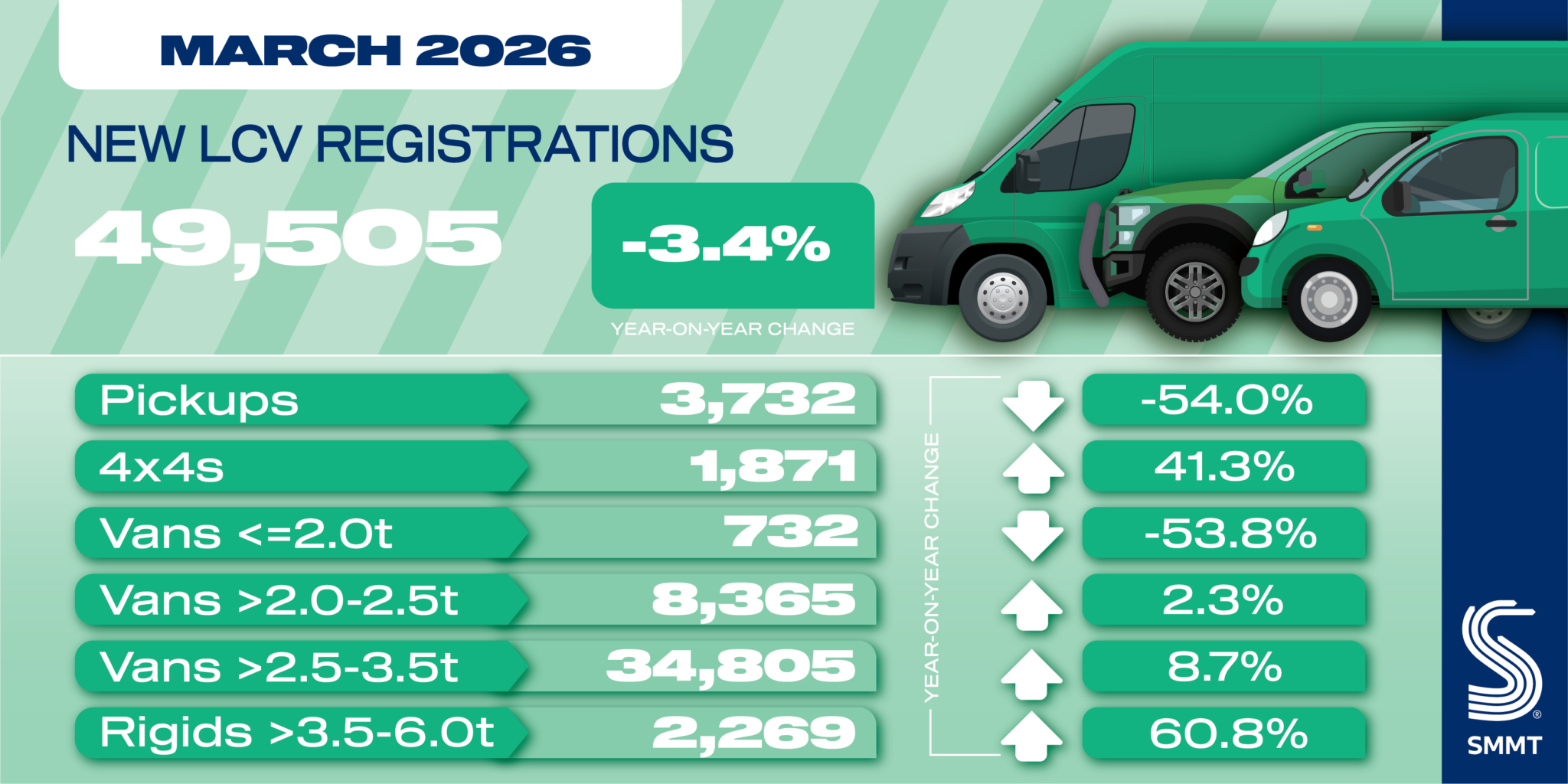
The UK’s new light commercial vehicle (LCV) market declined by 3.4% in March, with 49,505 vehicles registered, according to the latest figures published by the Society of Motor Manufacturers and Traders (SMMT).
The Weakest Since March 2023
The weakest new number plate month since March 2023 is disappointing, considering the month typically delivers the highest volumes of the year, but comes amid challenging economic and business conditions, according to SMMT.
Demand for large van models rose by 8.7% to 34,805 units, and medium-sized vans by 2.3% to 8,365 units, the latest UK LCV data shows. Uptake of small vans, meanwhile, fell by 53.8% to 732 units following a 60.8% uplift in March last year, with such fluctuations more naturally occurring in smaller volume segments.
A 15.9% decline in battery electric van (BEV) in March is also a significant concern, with just 3,543 units registered and a market share of 7.1%, the weakest since September 2024. Diesel continues to dominate, accounting for more than eight in 10 (85.6%) new UK LCV registrations. With manufacturers offering some 40 different zero-emission models – more than half of all models available – the decline underlines the immense challenge of decarbonising the sector. Indeed, while BEV demand has grown by 4.3% across the first quarter of 2026, it represents only 9.0% of the overall market, just over a third of the 24% share mandated for the year.
Recent announcements such as the extension of funding for the Plug-in Van Grant until 2027, the new Depot Charging Scheme and proposed changes to planning rules for private charger installations will help, as fleet confidence is constrained by the higher upfront cost of BEV purchases and depot infrastructure, as well as a paucity of LCV-suitable public charging. With natural market demand far behind mandated ambition, the sector continues to call for the government to bring forward a holistic review of the van transition.
Mike Hawes, Chief Executive at SMMT, commented: “A weak March is deeply concerning given this number plate change month often sets the tone for the year. Moreover, with fleet renewal now having contracted in 14 of the past 16 months, it reflects poorly on overall business confidence. A thriving market is essential not just to economic growth but to decarbonisation, and it is increasingly alarming to see BEV demand waning when it must accelerate to reach ever-tougher mandated levels. With the transition already falling behind schedule, a holistic review of the transition is urgently needed.”
Image credit: SMMT