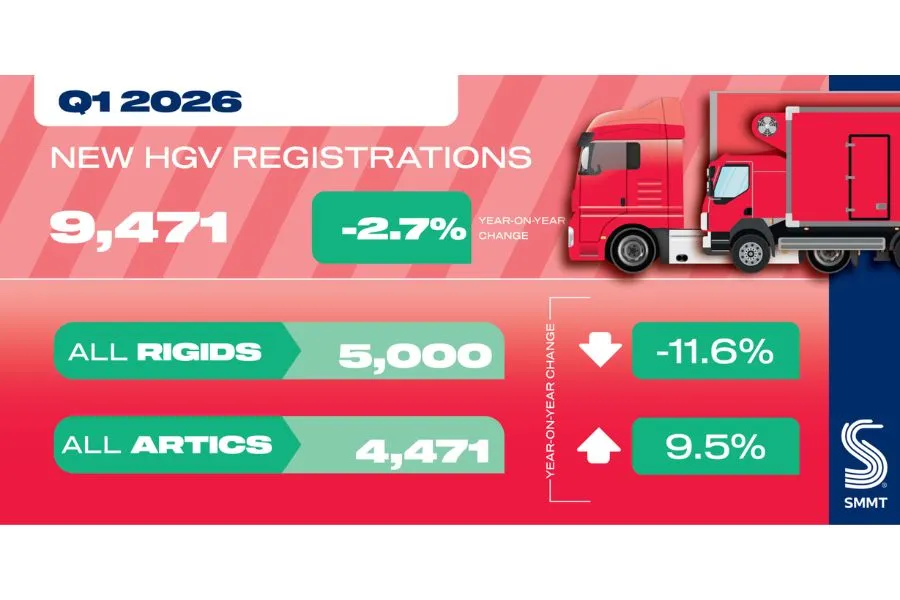
According to the latest data from the Society of Motor Manufacturers & Traders (SMMT), the bus registrations in the UK declined by almost 40% in Q1 2026.
Q1 Data
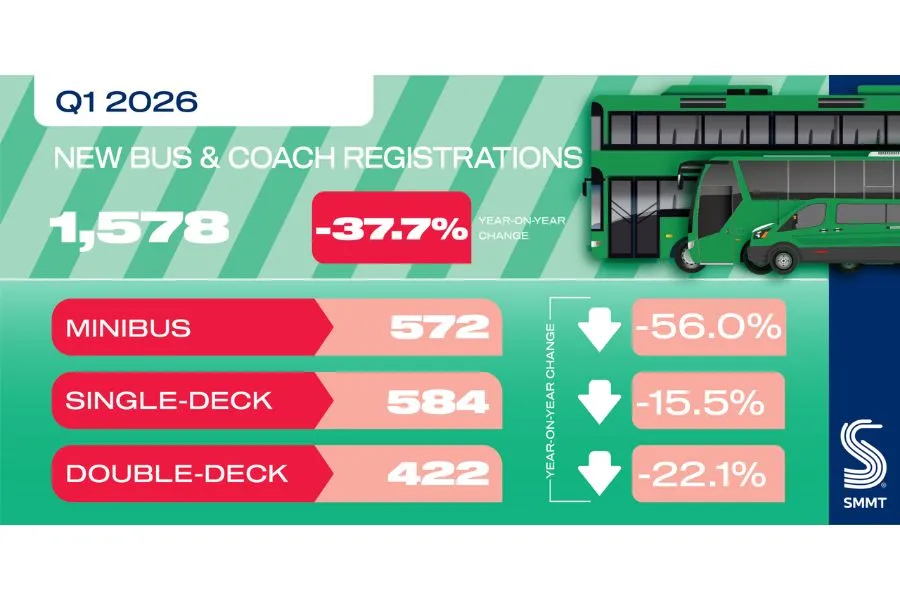
Registrations of new buses, coaches and minibuses declined by 37.7% in Q1 2026, with 1,578 units, as demand eased following last year’s 17-year high, according to SMMT.
The third consecutive quarterly decline was driven primarily by a 56.0% drop in minibus registrations, from 1,299 units to 572 units. The wider market also softened, with single-decker registrations down by 15.5% to 584 units and double-deckers down by 22.1% to 422 units. The year-on-year fall is amplified by comparison with an unusually strong Q1 2025, when overall registrations surged by 49.8% thanks to Zero Emission Bus Regional Area (ZEBRA) grants.
Zero-emission bus volumes declined by 20.4% to 588 units, yet outperformed the overall market as nearly two in five (37.3%) new buses registered were ZEVs – a record market share and clear evidence of the sector’s rapid transition to electric and hydrogen.
With the market slowing after two years of growth, recent announcements augur well for future growth. The government’s vision for buses, published at the start of April, aims to make bus journeys simpler and more affordable for passengers, helping boost ridership, and the local authority’s zero-emission bus order pipeline anticipates a further 23,381 deliveries by the end of 2035. However, support is still needed, particularly for local authorities that face greater challenges in transitioning to zero-emission bus fleets, such as those in more rural areas.
According to SMMT, stimulating investment into fleets will help accelerate the decarbonisation of road transport while also delivering significant improvements in air quality and reducing noise pollution across the UK. Action is needed, however, to speed up grid connections at bus depots, which often require significant, costly upgrades to provide the power needed to keep fleets fully charged.
Mike Hawes, Chief Executive, SMMT, explained: “After the bus market’s boost over the past two years, a decline was always inevitable as the market stabilises. With zero-emission buses taking such a high market share, however, all signs point to a market that is eagerly transitioning. Manufacturers have made massive investments in zero-emission buses and public funding schemes have helped drive adoption. With more local commitments to ZEV bus procurement, the market can grow, and the UK can get ever closer to a nationwide zero-emission bus network.”