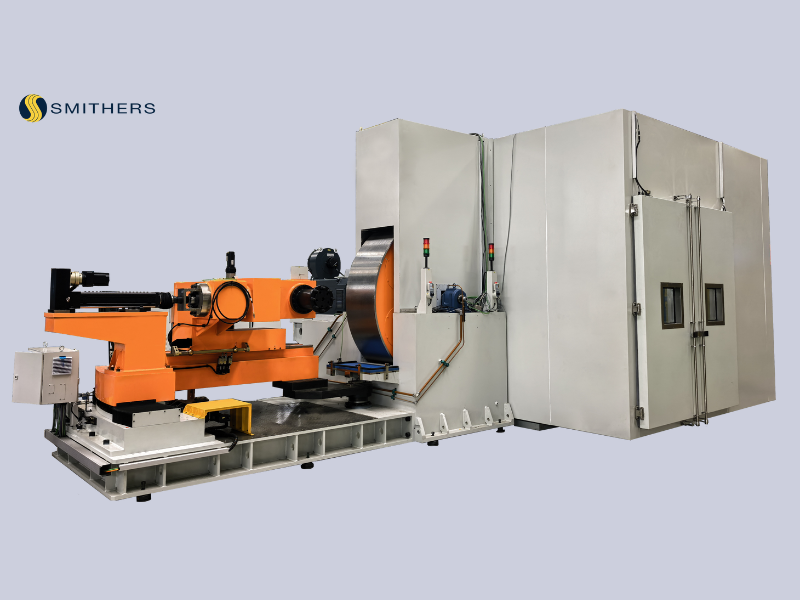
Smithers has expanded its testing capabilities in Suzhou with three new rolling resistance testing methods. They deliver automotive manufacturers and tyre makers deeper, more realistic insights into vehicle energy performance.
Enhanced Rolling Resistance Testing Capabilities Introduced in Suzhou
Smithers, a leading provider of testing, consulting, information, and compliance services, announces the addition of three specialised rolling resistance testing capabilities at its tyre and wheel test centre in Suzhou, China. These new capabilities deliver more comprehensive insight into vehicle operating scenarios. They recreate a wider range of real-world conditions in a controlled lab environment.
New Rolling Resistance Testing Methods for Real-World Accuracy
The new testing capabilities include:
Rolling Resistance Testing with Slip/Camber Angle for PCR and LT Tyres
Traditional rolling resistance testing is conducted at 0° slip and camber angles. However, factors such as wheel alignment, steering inputs, and changes in vehicle body attitude can cause slight variations in slip and camber angles during real-world driving.
This new capability simulates a broader range of slip and camber angle scenarios, giving automotive OEMs deeper insight into vehicle energy loss linked to alignment parameters. Tyre manufacturers can also evaluate how angle variations influence rolling resistance and use this data to optimise tyre structure and tread design.
High- and Low-Temperature Rolling Resistance Testing for TBR Tyres
Changes in rolling resistance are a key factor affecting vehicle range during winter. Regulatory standards are typically based on a narrow temperature window. In response to client feedback, Smithers invested in high- and low-temperature rolling resistance testing capabilities for PCR and LT tyres in 2022. They have now expanded this capacity to accommodate a broader range of tyres.
Rolling Resistance Testing with Chassis Components for PCR and LT Tyres
Chassis components such as half-shafts and brake discs can significantly affect a vehicle’s long-term range. Yet, there is a shortage of specialised indoor testing equipment capable of independently measuring their resistance. Using a proprietary new design, Smithers can now mount chassis components during rolling resistance testing to obtain data on both tyre-only resistance and the combined resistance of tyres and chassis components. This allows engineers to calculate chassis-component resistance and gives OEMs essential data to optimise vehicle energy loss.
All three testing capabilities are expected to be fully operational by 1st December 2025.
Industry Demand for Real-World, Scenario-Based Tyre Testing
“Smithers is seeing increased demand on a global scale for testing of tyres and vehicles that more closely mimics real-world conditions,” said Derek Read, Vice President of Asia Pacific / Global Development, Materials Science and Engineering, Smithers.
“These new capabilities are strategic investments into the refined, scenario-based testing our clients require to improve both tyre and tyre-chassis-vehicle system performance.”